sourceLinkedTitle
There are many more reasons for using Twitter post aggregators but let’s get to the tools. Here are 12 of those services with our favorite 5 to start.

Twitt(url)y - If you like the Digg interface and you like Twitter, then this is the tool for you. Rather than users’ votes, Twitturly counts links posted on Twitter to content in order to include and then rank the content. The more votes an item gets, the higher it displays on the list. Only the top 100 items are shown at a time. Twitturly also tracks the number of Tweets with links that a particular Twitter user has posted. This is a nifty feature that can help you see what a particular Twitter user likes and how ofter their Tweets with links get Retweeted by others. Twitturly also gives you the full Tweet History of a URL including how many and who Tweeted it, plus the total estimated reach, regardless of how many URL shortening services were used to point to it. By Joel Strellner

Retweetist - On this site you’ll see a variety of data aggregated all in one place. There’s a list of the freshest, most often Retweeted items, the most Retweeted items in the past 24 hours and the most Retweeted Twitter users. You can also see the Retweet history of an individual Twitter user which shows their daily Retweet frequency and the most recent items they’ve linked to. Here’s mine. By Mike Sheetal
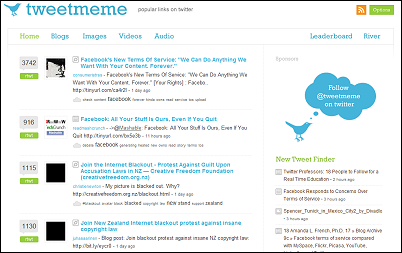
Tweetmeme - Unique features with this service include segmenting the kind of content being linked to: Blogs, Images, Video and Audio. There are mini keyword tag clouds for each Tweet. Other features include: A river of news page with an RSS feed, individual RSS feeds for each category (e.g. images, videos) and historic pages so you can go back to any particular date at 5 minute intervals to see what tweetmeme looked like in the past. By Nick Halstead

TweetLists - This service simply shows the most popular links over the last 24 hours found on the public timeline at Twitter.com. There are tabs for most popular Tweets of the day and week. There are also lists of the top Twitterati and domains being Tweeted. A search feature makes it easy to locate specifics. By Scott Rutherford

Twitter Search - Probably the most popular way to filter Twitter noise is to use the search tool. Trending topics are displayed and an array of search operators/options allow you to be pretty specific about what you’re looking for.
As an example, let’s say I wanted to find: “people in Chicago that asked a question in English about social media in the past 24 hours”. No problem, here you go. You can subscribe to the RSS feed of the search results as well. There are amazing possibilites for connecting with the right people using Twitter search.
Additional Twitter aggregator and filtering services include:
- Twistori - A sort of emotional Tweet aggregator: Love, Hate, Think, Believe, Wish. By Amy Hoy and Thomas Fuchs
- Twist - This service shows aggregated data about what people are saying in Twitter and includes a chart of topical trends in Twitter (similar to Google Trends) that you can also use to view Tweets during different time periods. Mont You can also do topic comparisons and drill down to see lists of what was hot today or the current week. By Diego Basch
- retweetradar - A tag cloud of Tweeted topics is what stands out with this service, showing current tags, today and yesterday for time intervals. Clicking on the tagged keywords initiates a search on Twitter itself. The “What’s Happening Right Now” section updates in real time. The top Retweeted links and Twitter users are also displayed along with a trend archive. By Minnesota’s own Ben Hedrington
- twopular - This service shows trending topics in various time formats: now, past 2 hours, 8 hours, day, week, month, ever. Each trending topic has an arrow indicator indicating direction of trend plus links to the topic on Google and Yahoo News. There’s also an option to do comparison charts from a preset list of trend topics. By Martin Dudek
- Twitturls - Shows popular articles, pictures and videos linked to via Twitter in the past 2 hours, today and also filters out any Tweets that don’t use Twitter vernacular. By Justin Palmer
- Twitlinks - Aggregates the latest links from the worlds top tech twitter users in a news story format.
- Retailer Twitter Aggregator - As the name implies, this is a retailer Twitter aggregator showing an ”at a glance” view of how brick and mortar retailers are using Twitter to connect with their customers including sales information advice. By Tom Sullivan
There are quite a few more, but none that do anything dramatically different than the services listed above. However, there may be some I’ve missed. Are there any unique Twitter aggregation tools that should be added? We’d love to hear about them.

![[StumbleUpon]](http://www.toprankblog.com/wp-content/themes/TopRank06/images/stumble-big.png)
![[Sphinn]](http://www.toprankblog.com/wp-content/themes/TopRank06/images/sphinn-big.png)
![[Google]](http://www.toprankblog.com/wp-content/themes/TopRank06/images/google-bookmark-big.png)
![[Facebook]](http://www.toprankblog.com/wp-content/themes/TopRank06/images/facebook-icon.gif)
![[Twitter]](http://www.toprankblog.com/wp-content/themes/TopRank06/images/twitter.png)
iRobt openIDeas syndicNation rePosted referedSources tweetAggregators allLinksOrigional